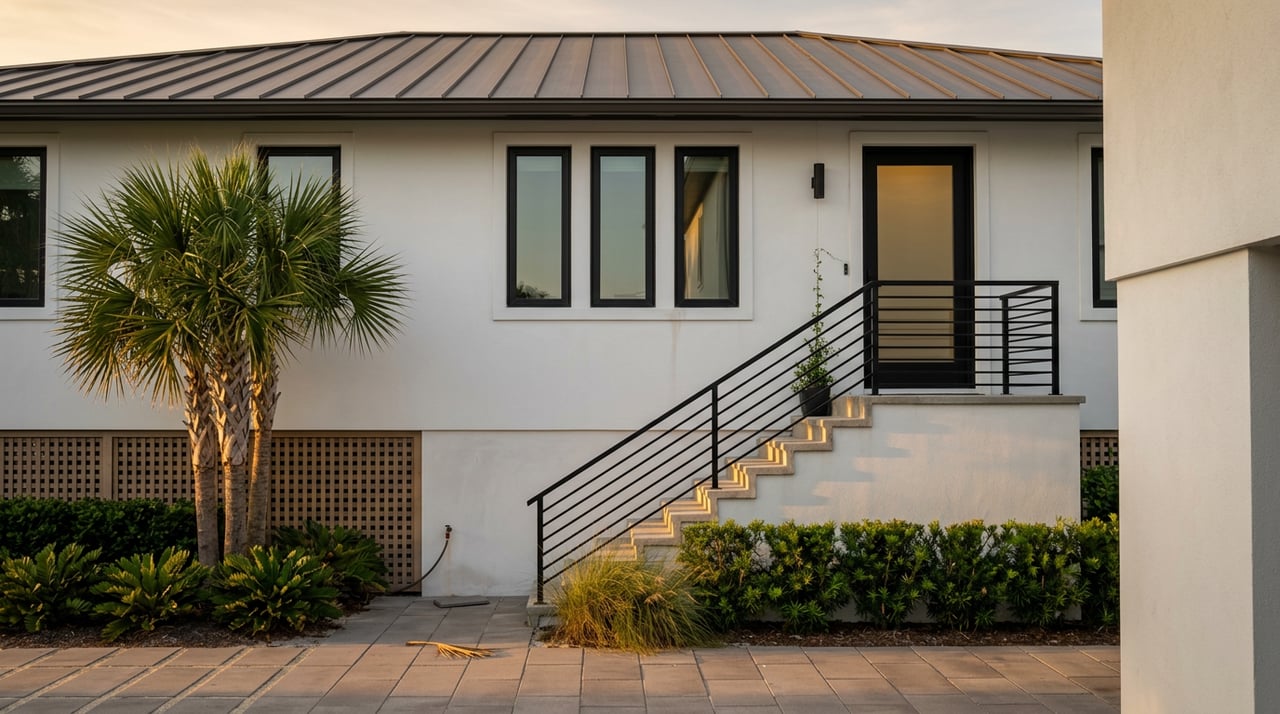
Pull up a handful of sites this week and ask what a home costs in Neptune Beach, and the answers will not agree with each other by hundreds of thousands of dollars. As of the first week of August 2026, one tally of the town's roughly 49 active listings puts the average asking price at about $1.42 million. A separate count of the same pool of listings puts the median list price closer to $1.3 million. Meanwhile the median price actually closing on those same streets in early August sits around $800,000. Zillow's broader estimate of what every home in town is worth, whether it sold recently or not, lands at $705,983.
None of those numbers is wrong. They are answering four different questions about a town small enough that any one of them can move by tens of thousands of dollars depending on which handful of closings happened to land that particular month. If you are comparing Neptune Beach to other First Coast beach towns using a single headline figure, you are comparing apples to a fruit basket.
Same Town, Four Different Denominators
Neptune Beach holds about 7,200 residents on roughly 2.3 square miles of land, squeezed onto a barrier island between the Atlantic Ocean and the Intracoastal Waterway. The active inventory at any given time tends to sit in the low 40s to high 40s. That is a small enough sample that a single oceanfront rebuild closing at $5 million, or a single fixer-upper duplex closing at $295,000, changes the average meaningfully. Asking price and closing price are also measuring two different moments in the same transaction, separated by whatever negotiation happened in between.
| What's being counted | Figure | Snapshot |
|---|---|---|
| Average asking price, active listings | about $1.42 million | Aug 8, 2026 |
| Median list price, active listings | about $1.3 million | Aug 8, 2026 |
| Median sold price, recent closings | about $800,000 | early Aug 2026 |
| Average estimated value, all homes | $705,983 | early Aug 2026 |
A seller pricing a listing this month and a buyer trying to figure out what a fair offer looks like are usually pulling from different rows of that table without realizing it. The gap between them is not market direction. It is structure.
The Line That Actually Splits The Market
The structure has a name locals already use: A1A. East of it, Neptune Beach is walkable to Beaches Town Center, where restaurants like North Beach Fish Camp, Slider's Oyster Bar, Flying Iguana, Coop 3003 and The Local sit within a short walk of Southern Grounds & Co. for coffee and boutiques like Jaffi's and The Bookmark. Lots here run smaller, the stock skews older, and proximity to the sand and the walk to dinner both get priced in.
West of A1A and closer to the Intracoastal, the town changes shape. Lots get larger, foliage gets denser, some homes back directly onto the waterway with private boat slips, and a handful of quieter, more planned pockets replace the tight grid near the beach. Buyers there are typically trading a five-minute walk to the ocean for more land and more privacy.
That single road does more to explain the spread in the table above than any month-over-month market trend does. A $1.3 million median list price pulled heavily from east-side inventory and an $800,000 median sold price pulled from a mix that includes west-side and original-condition homes are not describing the same market, even though they are describing the same zip code.
1948 Or 2024 Matters More Than Square Footage
Layer a second divide on top of the first: what year the structure was actually built, and whether it has been touched since. Neptune Beach's housing stock runs from concrete block beach cottages built in the late 1930s through brand-new construction completed as recently as 2025, and the gap between those two ends of the timeline shows up constantly in what is actually for sale. One recent listing on Hopkins Street, two blocks from the ocean, advertised a full rebuild to the studs, with new electrical, plumbing, mini-split HVAC, spray foam insulation and Fisher & Paykel kitchen finishes. A few blocks away, a different listing marketed one of the last remaining original 1948 brick duplexes east of A1A on its original lot, explicitly pitched as a renovation candidate. A third listing offered two separate buildable lots, each roughly 107 by 50 feet, priced essentially as land.
That is three different products sitting inside the same average. A buyer chasing the lower end of the price range in Neptune Beach is not buying a smaller version of the $1.4 million average asking price. They are usually buying either a structure that needs real work or a lot that needs a builder, and the math on that path runs through the town's own construction rules, not just the purchase price.
What A Rebuild Actually Requires Here
If the plan is to buy toward the affordable end and rebuild, Neptune Beach's floodplain rules apply before a shovel goes in the ground. The city requires an Elevation Certificate on FEMA Form 81-31, signed by a licensed architect, engineer or surveyor, for any new construction in a special flood hazard area. In an AE flood zone, the finished floor of the living space has to sit at least one foot above the base flood elevation. In a VE or Coastal A zone, it is the lowest horizontal structural member of the lowest floor that has to clear base flood elevation by that same margin, and any enclosed space below that line has to use flood resistant materials with proper openings.
None of that is unusual for a barrier island town, and it is not a reason to avoid building here. It is a real line item and a real timeline addition that a buyer comparing a $700,000 fixer to a $1.4 million turnkey home needs to price in before deciding which one is actually cheaper.
The New Line Item Coming For New Construction
There is a second cost variable forming right now that has nothing to do with the ocean. Neptune Beach's City Council voted in April to solicit proposals for an impact fee study, and in late July the city selected Raftelis Financial Consultants, a Charlotte-based public sector consulting firm, to prepare it. Jacksonville Daily Record's coverage of the selection notes the city is weighing one-time charges on new residential and commercial construction to help fund future infrastructure, separate from the operating shortfalls it is already managing. City Finance Committee Chair Brent Rogers told the council plainly, "We have a $900,000 IOU in our sanitation fund," a shortfall the general fund has been covering rather than user fees.
Under Florida law, any impact fees that come out of this study can only fund new infrastructure capacity tied to growth, not existing deficits, so the sanitation shortfall and the impact fee study are technically separate problems the city is trying to solve at the same time. But for anyone eyeing one of Neptune Beach's remaining buildable lots as the value play, a new one-time development charge is worth watching as this study moves through public workshops in the months ahead.
What This Means If You're Comparing Beaches
If you are cross-shopping Neptune Beach against Atlantic Beach or Jacksonville Beach using a single median number from any one site, you are missing the question that actually matters here: which side of A1A, and how old is the roof. A quoted median of $800,000 and a quoted average of $1.42 million can both be true at the same time in the same town, because they are describing different inventory, not different moments in a rising or falling market.
The practical version of this for a buyer is simple. Decide first whether you are shopping for walkability to Beaches Town Center or for space and water access, then decide whether you want a finished home or a rebuild candidate, and only then does a specific listing's price start to mean something comparable to another listing's price. Treat any single "median home price in Neptune Beach" headline as a starting question, not an answer.
A Few Direct Questions
Is Neptune Beach currently a buyer's market or a seller's market? The list-to-sold gap this year, combined with how much the small inventory count swings month to month, makes any single market-temperature label unreliable at the town-wide level. The honest answer depends on which side of A1A and which vintage of home you are asking about.
Does every home in Neptune Beach carry an HOA or CDD? No. Many single-family homes carry neither. Some townhouse and condo communities do carry monthly dues, which recent active listings show running roughly $100 to $280 a month as of early August 2026, generally covering shared amenities and common area maintenance rather than a citywide assessment.
What's the real trade-off between buying east of A1A versus toward the Intracoastal? East of A1A buys a shorter walk to the beach and to Beaches Town Center's restaurants and shops, usually on a smaller lot with older bones. West toward the Intracoastal buys more land, more privacy, and in some cases direct water access, at the cost of that walkable proximity.
If you are trying to figure out which version of Neptune Beach actually fits your budget and your priorities, a single online estimate will not get you there. Holly Reaves works this market block by block, from the original-condition cottages east of A1A to the rebuild lots near the Intracoastal, and can walk you through what a specific street, lot and structure actually justify before you make an offer. Work With Holly to get the real number behind the headline.
